Answer 4 questions to find out how to recover more carts
Question 1 of 425%
Do you already send abandoned cart reminders?
According to the Baymard Institute, nearly 70% of e-commerce carts are abandoned before checkout. Most online shops still rely on email campaigns that all too often end up in spam or in their shoppers’ “Promotions” tab.
Yet to win back a hesitant customer, your strategy should build on the immediacy and interactivity of mobile channels (SMS, RCS and WhatsApp). Find out how these conversational channels let you engage your customers directly and recover up to 3 times more carts.
Why do customers abandon their carts?
Friction at checkout
When customers reach the final page to complete their purchase, every unnecessary step raises the risk of abandonment. Being forced to create an account, for example, immediately puts off shoppers in a hurry.
Likewise, if your site doesn’t inspire trust (sloppy design, missing legal notices, no verified reviews), visitors may well leave without completing their order.
The payment process
Unexpected extra fees or an overly complex payment process push shoppers straight to abandoning their order. And if the choice of payment options is limited or the transaction feels insecure, the purchase is likely to stall.
Delivery terms
Shipping conditions play a decisive role in the final choice of a product. Delivery that feels too slow or too expensive often leads shoppers to abandon the items they picked. On top of that, an unclear, restrictive or paid returns policy immediately raises objections.
Psychological barriers
Not knowing the brand is a major barrier to conversion on a first purchase from your online shop. Prospects often hesitate to complete their order if they aren’t reassured about the product’s quality, the brand’s story or other shoppers’ experiences.
A large share of unfinished orders also comes down to a lack of real urgency: many shoppers use their cart as a reminder or to compare offers, with no immediate intention to buy. This is especially true on smartphones, where the slightest notification or distraction can hold up the purchase.
Why send an abandoned cart reminder?
Recover revenue
A targeted reminder is a fast, profitable way to turn purchase intent that is already there into a sale. Driving qualified traffic takes a great deal of effort and marketing budget, so it would be a shame to lose interested visitors. By prompting shoppers to complete the carts they left behind, you raise your overall conversion rate.
Understand and overcome purchase objections
An abandoned order often reveals friction in your customer journey. Sending reminders before shoppers give up for good helps you spot the technical issues or doubts that hurt your conversions. When several customers point to the same difficulty, you immediately know which blocker to fix first. These messages let you remove those barriers and smooth out your customer experience.
Improve customer experience and brand image
Personal outreach shows that you listen to your customers, which enhances your brand. Rather than sending generic, impersonal marketing campaigns, send a tailored message that helps the shopper choose their products. This relationship-driven approach builds trust in your brand and encourages loyalty from the very first exchange.
What are the limits of abandoned cart emails?
Inbox overload
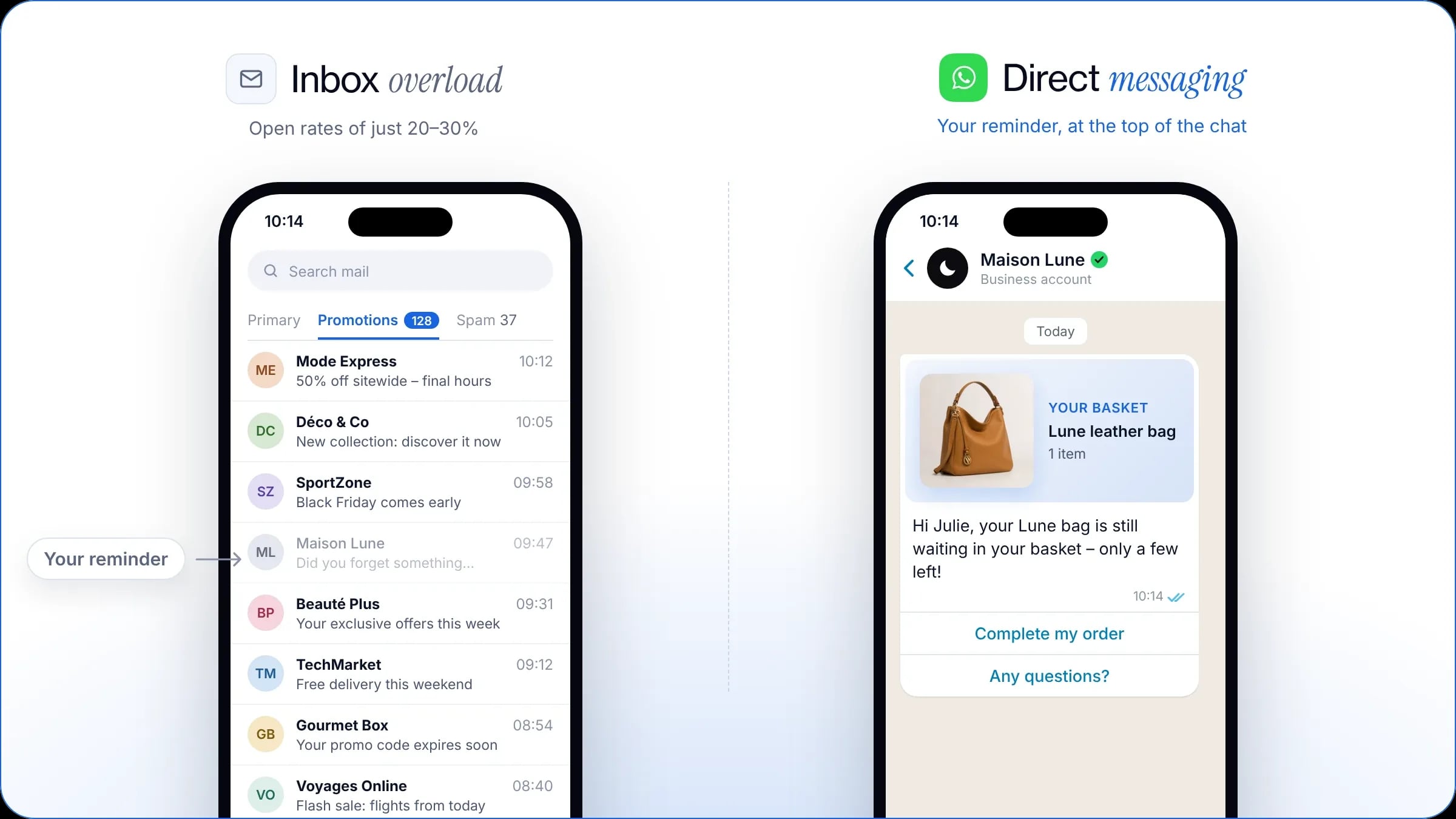
Traditional email marketing is saturated today, which greatly reduces the impact of a reminder email. With open rates that usually top out at 20 to 30%, most of your sends go unseen. Your message very often lands in the “Promotions” tab or straight in spam, when it isn’t simply buried among other sales messages. This channel doesn’t give you the visibility you need to prevent cart abandonment.
The time lag
An email is usually opened hours or even days after the cart was abandoned, by which time the shopper’s sense of urgency has completely faded. In the meantime, your prospect has moved on, turned to a competitor or simply forgotten the products they picked. This delay weakens your reminder and stops it from recovering carts effectively.
No interactivity
Being one-way by nature, a standard email can’t start an exchange to clear the doubts that hold your customers back. Unlike conversational channels, when a shopper has a question about a product, delivery or payment, this format can’t answer those objections in real time.
SMS, RCS and WhatsApp for abandoned cart recovery
Channel comparison for abandoned cart recovery
Channel
Open rate
Cart recovery rate
Main benefits
Best use
Email
~ 20 to 30%
8%
No length limit and minimal cost per send
Second or third reminder (D+1 or D+2) and formal communication
SMS
~ 97%
10%
Universal and instant
Second or third reminder and fallback
RCS
~ 80 to 95%
18%
Rich format (images, carousels, buttons)
First reminder
WhatsApp
~ 95%
20%
Rich, highly engaging conversational channel
First reminder and high-value orders
How do you orchestrate the 3 channels?
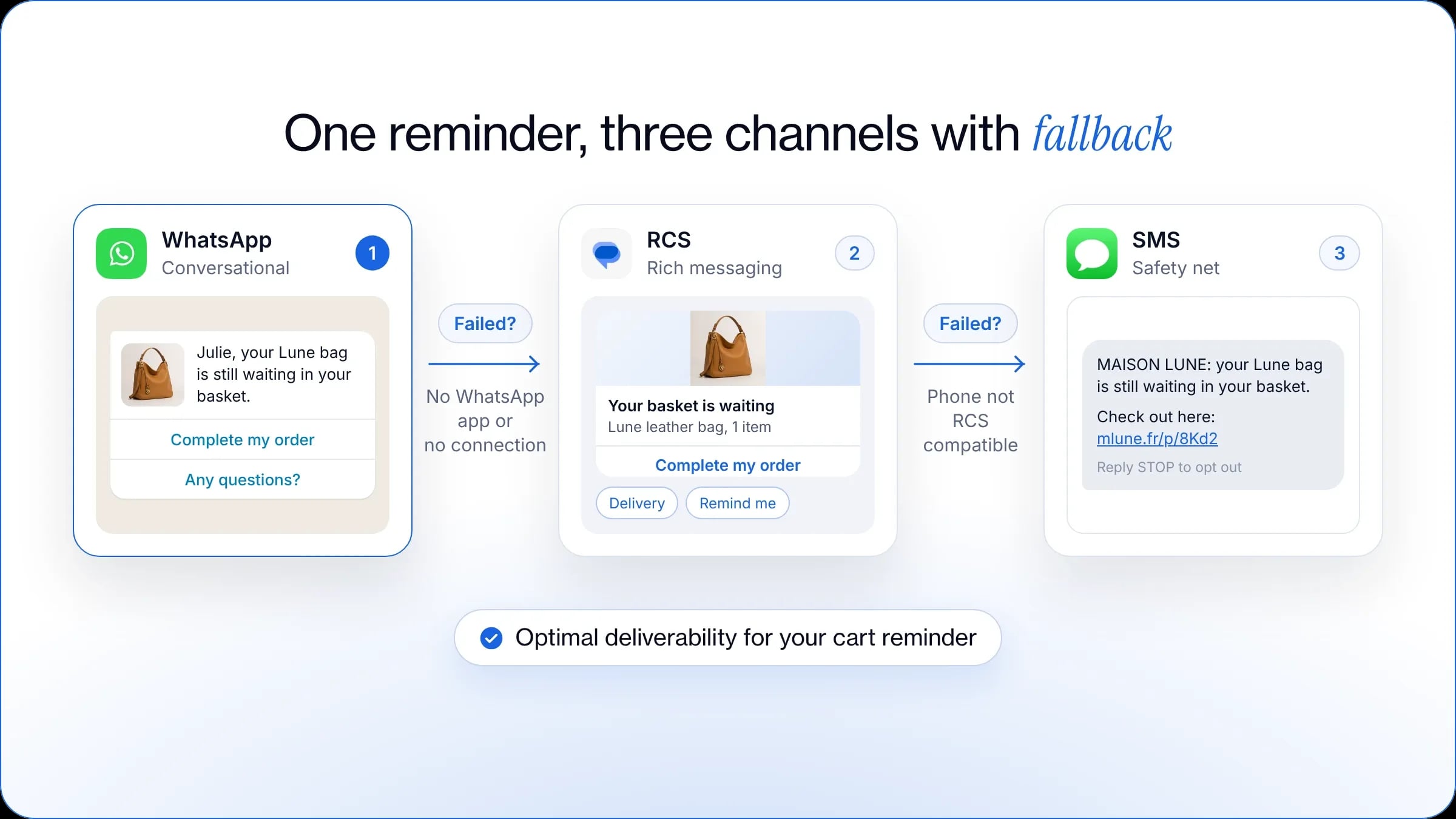
To recover as many carts as possible, orchestrate your mobile channels smartly with a fallback system. Send your reminder first on a rich, conversational channel such as WhatsApp or RCS, then switch automatically to a standard SMS if delivery fails (no internet connection, incompatible phone, WhatsApp not installed). This approach ensures optimal deliverability.
WhatsApp: the conversational channel that clears up doubts
With its official business profile and verified badge, WhatsApp creates a climate of trust that reassures shoppers. This rich channel also lets you show the abandoned product’s image, along with a catalogue of relevant alternatives. An action button then lets the customer complete their purchase in one tap.
WhatsApp’s real strength, though, lies in its interactivity and conversational nature: through chat or quick reply buttons, customers can ask their questions live and have their objections answered. This tailored support is ideal, and far more effective than email, for high-value carts.
RCS: an interactive experience right in the SMS inbox
Available straight in the smartphone’s native messaging app, RCS lets you send reminders without asking customers to download a third-party app. It also lets you show your brand’s logo and official name, add the forgotten product’s image and include a carousel of complementary items to spark your shoppers’ interest.
As a true conversational channel, RCS includes reply buttons and lets you chat with customers in real time to remove their purchase barriers. The shopper then only has to tap an action button to complete their order.
You can therefore build directly on your existing SMS opt-in base by sending RCS first, with an automatic fallback to SMS to guarantee your messages are delivered.
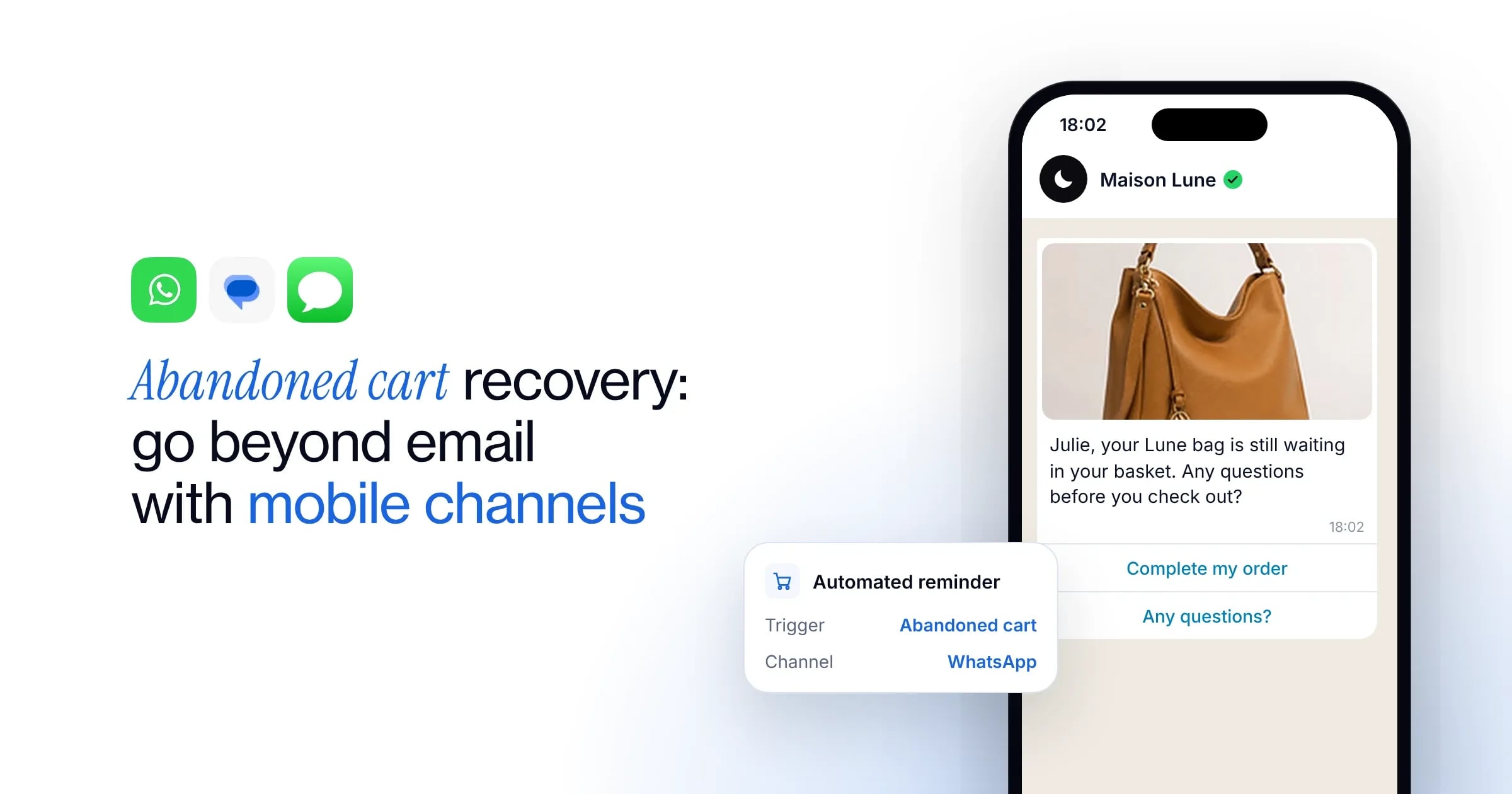
SMS: immediacy and urgency
SMS stands out for its short format, which plays directly on urgency. It can work well to prompt quick action before a limited-time offer expires. However, the format is far less interactive: it can’t carry visuals or receive customer replies.
This makes it a better fit for reactivation campaigns, for customers higher up the conversion funnel, or as a fallback to make sure the reminder gets through.
Use AI for your abandoned cart reminders
With AI, every reminder becomes a conversation. Shoppers ask their questions and get an instant answer, at any time of day. A question about the price, a doubt about returns: the AI answers on the spot, just as an in-store sales assistant would.
How do you get abandoned cart recovery right?
Choose the right timing
Test several delays for your reminder to find the strategy that works best for your brand. A reminder sent 30 minutes to 2 hours after the cart is abandoned catches shoppers while their purchase intent is intact and their smartphone still in hand.
We recommend sending from 30 minutes, especially on WhatsApp and RCS, because at that moment your prospect is probably looking at a competitor’s offer. With an average time to open of 7 minutes on these channels, delivering your message after half an hour helps you maximise your cart recovery rate.
For the rest of your sequence, the pace depends on how much marketing pressure your brand wants to apply, while protecting your WhatsApp account’s quality score. It is best to move follow-up reminders to SMS, keeping rich messaging for customers who have interacted with your site in the meantime.
A first reminder at H+24 gives your shopper time to think, while a second message at H+48 or H+72 plays on urgency before their cart expires.
Tailor the offer to the shopper’s profile
Personalise your reminder to your recipient’s profile: a prospect’s expectations are very different from a regular customer’s. For a first purchase from your shop, the priority is to reassure the shopper about the brand, the product or the reliability of the service. For a loyal customer or a particularly large cart, on the other hand, offer tailored support or an exclusive perk.
Choose the right channel for each customer
To maximise your chances of conversion, you can also analyse your shoppers’ history and prioritise the channel they respond to best.
Write a message that drives action
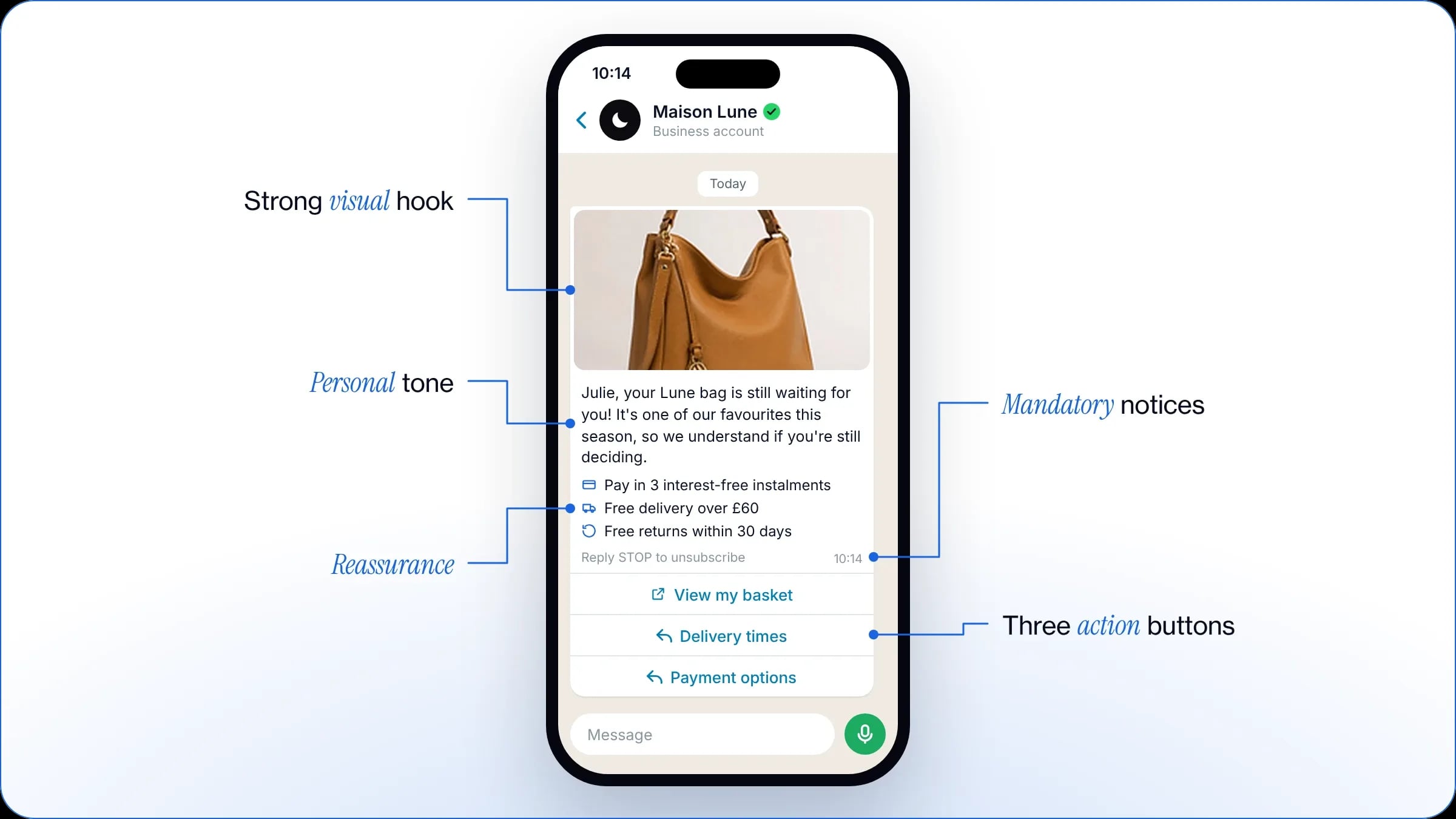
To make your abandoned cart reminder as effective as possible, your message should include:
A strong visual hook: add the product image, synced in real time with your e-commerce CMS.
A personal tone: go for a warm, caring tone focused on advice rather than sales pressure. For example: “Hi Julie, your favourite is still waiting for you! Still unsure about the fit or the fabric?”
Reassurance: put the shopper’s mind at rest about payment, delivery or any other sticking point. Add lines such as “Free delivery on orders over £50” or “Free returns within 30 days”.
Three strategic action buttons: a first CTA that leads straight to the cart, such as “Complete my order”, then two quick reply buttons for the most common blockers, such as “Payment” and “Delivery”.
Mandatory notices: include how to unsubscribe, such as “Reply STOP to opt out” for SMS or an “Unsubscribe” quick reply button on WhatsApp and RCS.
Use the right conversion levers
To turn hesitation into an order, you can play on urgency and scarcity, for example by pointing out that stock is limited. Use social proof too, by highlighting positive reviews from your shoppers or mentioning that the item is a bestseller.
If these arguments aren’t enough to remove the blockers, you can offer a targeted perk based on what the customer tells you about why they abandoned: free delivery, an exclusive gift, a discount and so on.
Segment your reminders by customer value
By cart value
For small amounts, the main goal is to keep sending costs down while prompting the purchase with a simple reminder. Avoid offering a discount or promo code straight away. Favour advice or play on urgency instead (“Only a few hours left before it sells out”).
For standard carts (around your average order value), make the most of the conversational, interactive side of mobile, especially WhatsApp and RCS, to reassure customers and answer common objections. If the shopper doesn’t convert after this first message, you can consider a targeted perk, such as free delivery, in a second reminder.
Finally, high-value orders call for highly personalised support. Abandonment here is often down to a need for in-depth advice, a psychological barrier around price or a technical check.
This is the segment where conversation is essential: use a conversational channel with advanced AI (such as WAX AI) or a human adviser. You can then include tailored offers, a discount or an exclusive perk to secure your sales.
By customer profile
For a prospect discovering your shop, your reminder should focus above all on reassurance. Highlight your verified business profile (WhatsApp or RCS), your customer reviews, your secure payment options or your returns policy to build trust.
For an existing customer, abandonment usually comes from a simple distraction on mobile or a moment’s hesitation. Use a personal tone and offer quick help or recommendations based on their purchase history.
Finally, a member of your loyalty programme expects recognition rather than a generic promotion. Remind them of their loyalty points balance or the credit they can take off their cart straight away, or offer them an exclusive perk such as free express delivery.
Abandoned cart reminder templates
On WhatsApp
Ideal for starting a direct dialogue, WhatsApp shows the product image instantly and offers quick replies to guide the customer all the way to checkout.
On WhatsApp, you can rely on:
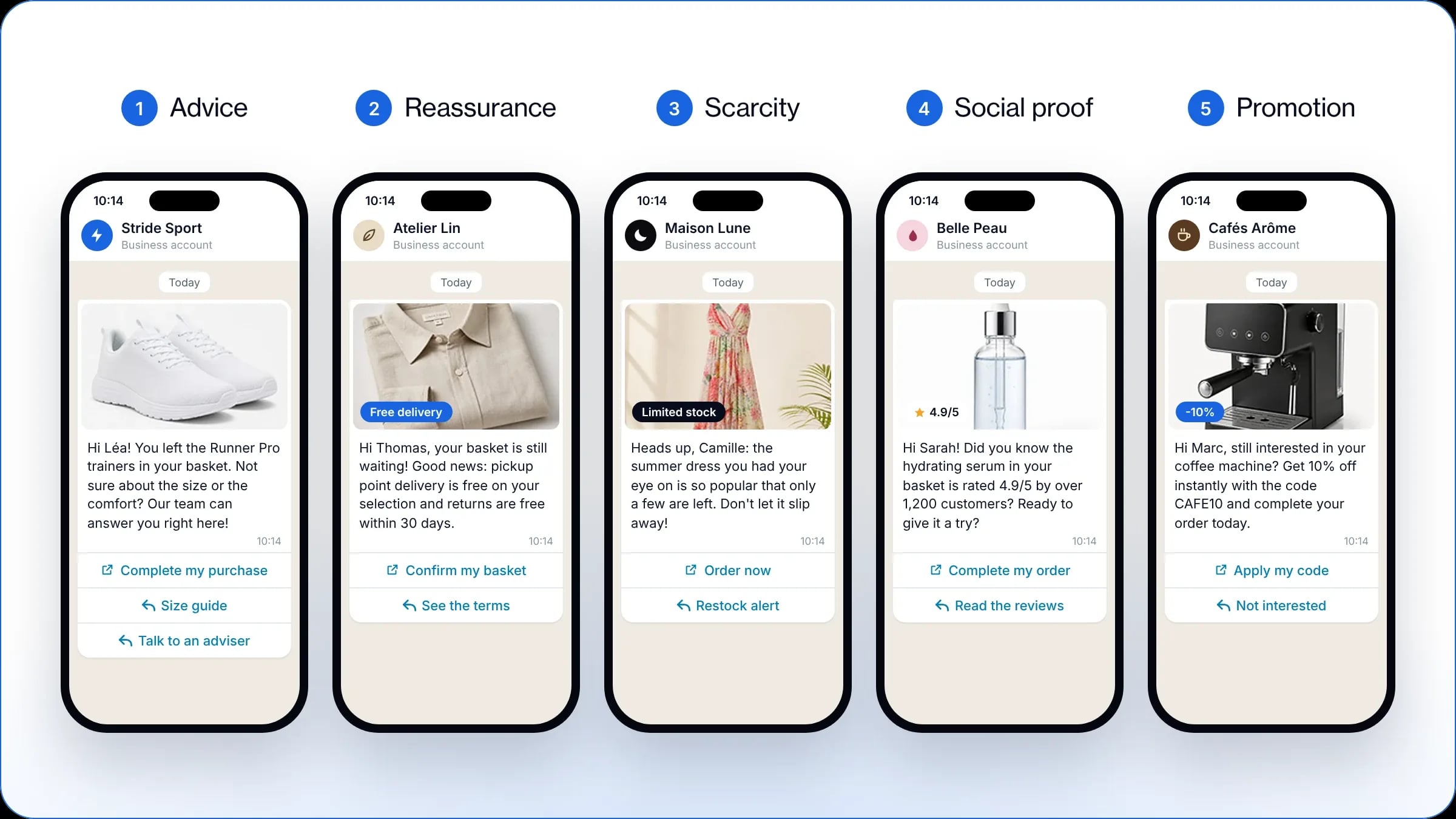
The advice-led reminder, ideal for opening the conversation and clearing doubts about a garment or a technical item.
The reassurance message, perfect for unblocking shoppers held back by payment or delivery terms.
The scarcity lever, effective for prompting a quick decision.
Social proof, which reassures undecided customers by showing how satisfied other shoppers are.
The promotional nudge, best kept for a second reminder or high-value carts to trigger the conversion.
On RCS
Built into the native messaging app on Android and iOS, RCS relies on visuals and interactive action buttons to get shoppers to complete their purchase. You can choose:
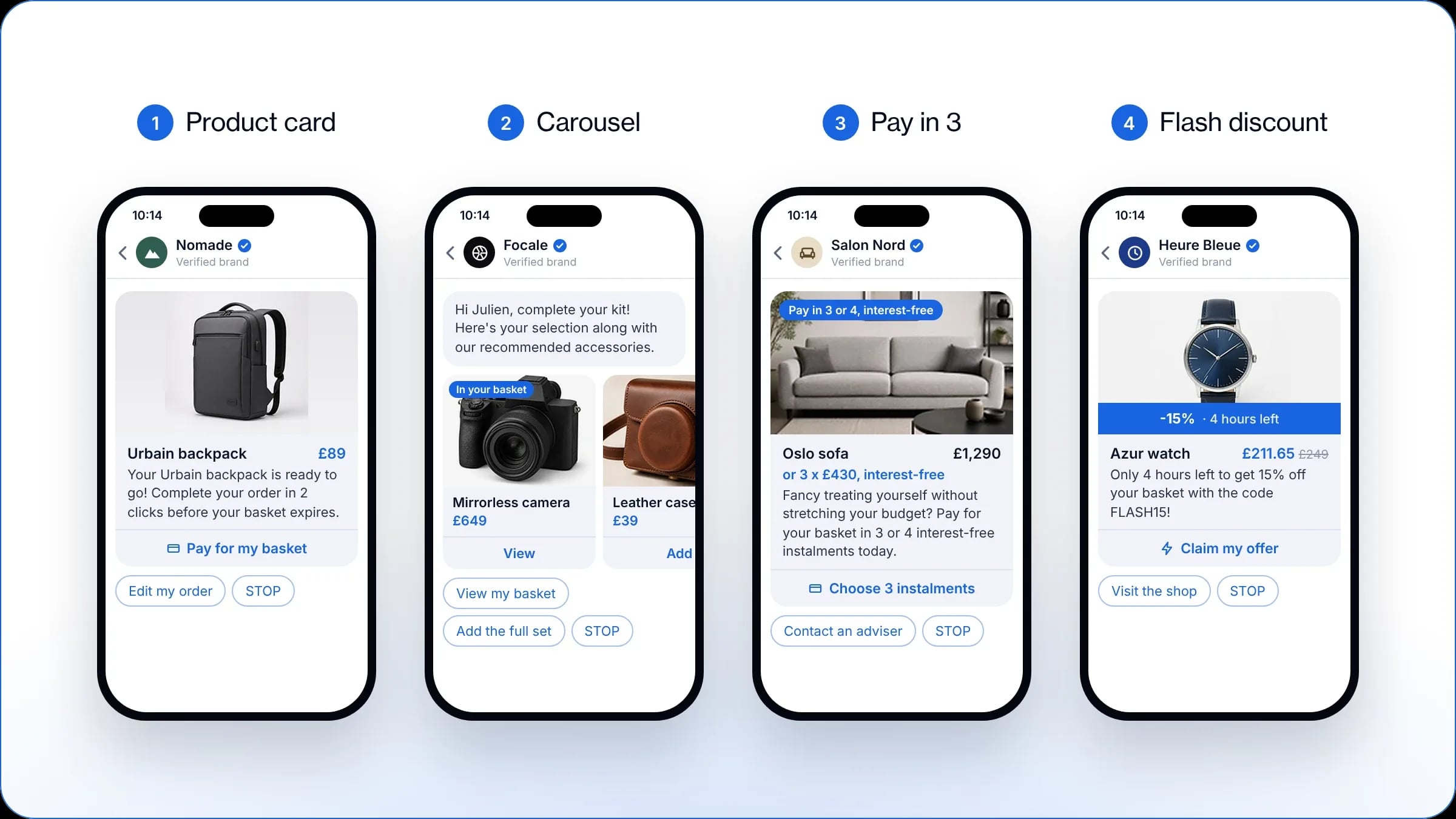
The immersive product card, which showcases the forgotten item with a visual and direct access to payment.
The suggestions carousel, which shows the abandoned item alongside similar products or complementary accessories to raise the average order value.
Flexible payment, which removes the barrier on large carts by offering to pay in instalments.
The flash discount, which pairs the reminder with a limited-time offer to create urgency.
On SMS
SMS relies on a concise hook and a short link to get your shoppers to complete their order. Focus on:
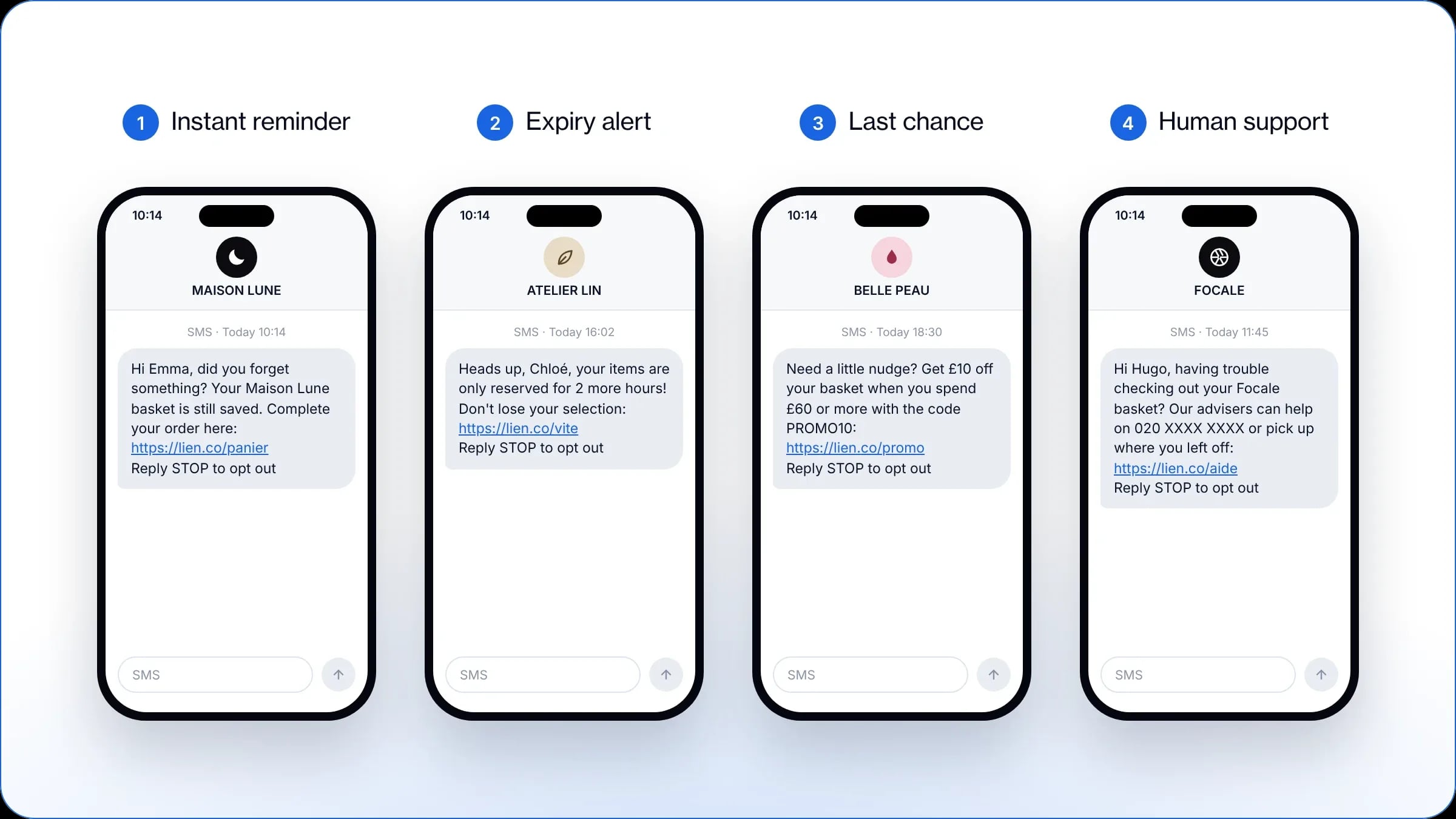
The instant reminder, sent soon after abandonment to bring the shopper back to the site without sales pressure.
The expiry alert, which creates urgency and prompts action.
The last-chance reminder with a discount to trigger the purchase.
The personal approach, which offers human help with a technical difficulty or a question.
A few reminder examples from our customers
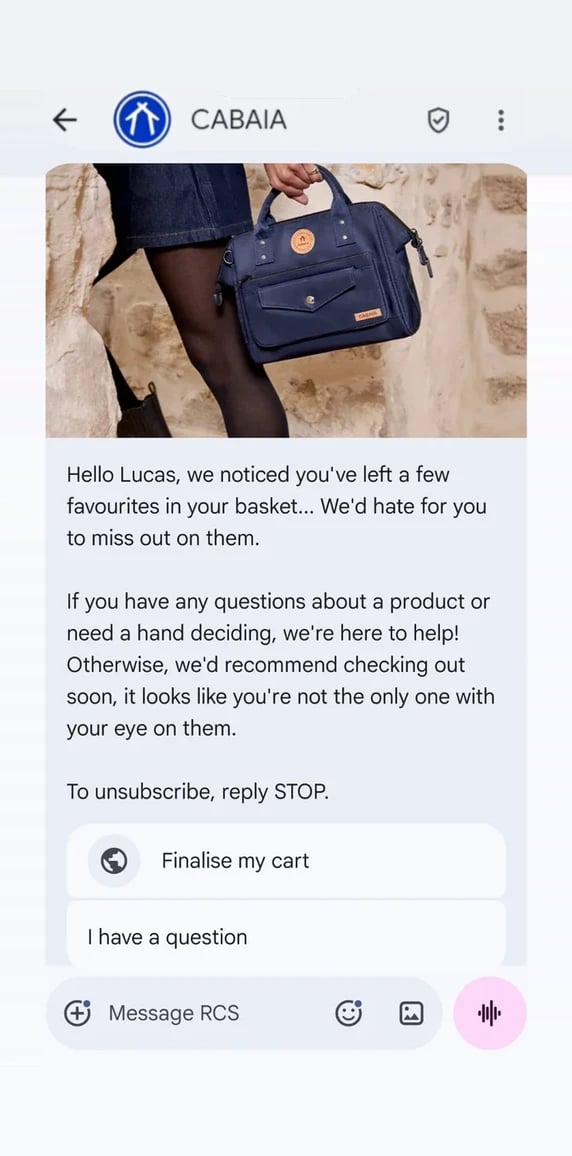
On WAX, our customers (such as Flotte, Ysé, Fusalp and CABAIA) rely on personal advice and an answer to every hesitation for their abandoned cart reminders.
What mistakes should you avoid in your abandoned cart reminders?
Sending a generic, one-way message
A message that isn’t personalised (product image, direct access to a pre-filled cart, etc.) hurts conversion. Likewise, sending the same message to a prospect discovering your online shop and to a loyal customer doesn’t work.
Make the most of conversation too (quick replies, AI, direct support) rather than one-way messages, which show their limits in email marketing.
Picking the wrong moment or overwhelming the customer
Waiting 24 hours to send a first reminder is a major mistake: purchase intent fades and the shopper may already have ordered from a competitor.
On the other hand, bombarding your customer with repetitive messages that add no value increases the risk of unsubscribes or blocks. On WhatsApp, this excessive pressure directly lowers your quality score, exposing you to sending restrictions or even account suspension.
Offering a discount in every message
Systematically offering a discount from the first abandoned cart reminder needlessly eats into your margin, when a simple visual reminder or reassuring message is usually enough to trigger a purchase.
This approach can also lower the perceived value of your products and your brand image. Keep price perks, gifts or free delivery as a last resort, targeting your loyal customers or particularly high-value orders instead.
How do you measure the ROI of your abandoned cart reminders?
Analyse your KPIs
To fine-tune your strategy, analyse your reminders’ performance indicators:
Deliverability and open rates, which confirm that the chosen channel reaches your audience.
Click-through rate, which measures how well your hook and action button work.
Conversion rate, which shows the share of users who complete their purchase.
Choose the right attribution model
Attribution tells you precisely whether your reminder led to the sale. Depending on the platform, several models exist to measure your campaigns’ impact:
Last-Click: the conversion is credited to your reminder only if the customer clicks the link in the message and completes the purchase right away. This very strict model ignores multi-step purchase journeys.
Interacted: the sale counts as soon as the recipient has interacted with your message before ordering, for example by tapping a quick reply button or asking a question in the conversation.
Open: the conversion is credited to your reminder as soon as the customer has opened and read your message within the set attribution window, then completed their order in your shop.
At WAX, we use the Open attribution model. On mobile channels such as WhatsApp, RCS or SMS, shoppers often receive and read your reminder on their smartphone, then switch to their computer (where their session and payment details are already saved) to complete their order. Tracking limited to Last-Click would underestimate your campaigns’ real ROI.
Set the attribution window
For reliable measurement, it is crucial to set a short attribution window (usually 24 to 72 hours for an abandoned cart). A window that is too long could wrongly credit an organic sale to your reminder.
Add UTM tracking
Make sure you add dynamic UTM tags to every link in your WhatsApp, RCS and SMS sends. This lets you see the exact revenue each channel generates, compare their performance and adjust your strategy.
What are the rules for abandoned cart reminders?
Governed in the UK by the PECR and the ICO’s guidance, alongside the UK GDPR, abandoned cart reminders require prior explicit consent (opt-in). The law does, however, make an exception for existing customers, known as the “soft opt-in”: if they have already completed a purchase from your shop, you can contact them about similar products without prior consent. For a new prospect, consent remains mandatory.
Every message must also include a clear, free way to unsubscribe, such as “Reply STOP” or an unsubscribe button.
Which criteria should you use to choose a tool for your reminders?
Native integration with your e-commerce CMS
To automate your abandoned cart reminders, choose a tool natively connected to your e-commerce CMS (Shopify, PrestaShop, etc.). This real-time sync gives you access to your product pages and item visuals, and lets you send a direct link to checkout.
It also makes segmenting your audience much simpler, by telling you whether you are dealing with a first-time visitor, a regular customer or a shopper whose average cart is usually high.
Easy set-up with AI
To make building your campaigns and automations easier, choose a platform compatible with MCP (Model Context Protocol). It connects your AI assistants (such as ChatGPT, Claude or Perplexity) directly to your messaging platform. For an even smoother experience, WAX Composer also lets you use AI right inside the platform, without switching tools.
You talk to your AI in plain language, as you would to a colleague, and it sets up your cart reminder flows, structures your rich messages and analyses your campaign results on WhatsApp, RCS and SMS.
Multichannel management
A reminder strategy relies on channels that complement each other. Choose a tool that lets you orchestrate WhatsApp, RCS and SMS from a single interface. It is the ideal way to match the right channel to each customer, and to switch on a fallback mechanism that ensures deliverability.
On WAX, the fallback is smart and native: if a WhatsApp message can’t be delivered, it switches automatically to RCS, then to SMS. You only have one reminder to set up, and each customer receives it on the best channel available on their phone.
Measuring return on investment (ROI)
To manage your activity effectively, your tool should also give you clear visibility of the revenue your reminders actually generate. Choose a platform that lets you set UTM tags and customise the attribution window.
FAQ
Use a personal tone, with the product image and reassurance about delivery, payment or any other sticking point. Add quick replies to clear the last doubts and a button that leads straight to the pre-filled cart.
Sync your tool with your e-commerce CMS to add the item’s visual and access the product page’s details. Add dynamic variables too, such as the direct link to checkout, and segment your audience to tailor the message to each target.
Thanks to native e-commerce integrations, ready-to-use templates and our AI tools (MCP and Composer), setting up a reminder on WAX takes just a few minutes. You can switch on an automated flow and preview it on your smartphone before it goes live. Book a personalised demo with one of our experts to optimise your strategy.
The best-performing slot is usually 30 minutes after abandonment, while purchase intent is still strong. Sending a reminder too late gives your competitors the chance to win the sale first.
Two to three messages at most are enough to maximise conversions without overwhelming your recipient. Leave time between sends, and avoid reminding customers several times on WhatsApp, as this can lower your quality score, expose your account to suspension or push your costs up considerably.
On WAX, you can automate your abandoned cart reminders. As soon as an abandonment is detected on your site, a WhatsApp message is sent to your customer with the product visual and reassurance. The recipient can then complete the purchase in one tap, or start a conversation with our AI or through quick reply buttons to clear up their doubts.
WAX is a conversational CRM for commerce that helps brands engage, convert, retain and support customers across WhatsApp, RCS and SMS. It connects customer, product and order data to personalised conversations, campaigns, automation and AI.
Traditional chatbots primarily answer customer questions. WAX combines customer data, campaigns, automation, commerce and AI across the customer journey to help brands engage customers, drive purchases, build retention and provide customer support.
WAX includes visual tools for building campaigns and automations without coding. Some integrations may call for technical input during setup.
Most brands launch WAX within two to three weeks, including channel verification and initial setup. Timelines depend on the channels, integrations and use cases required.
WAX supports WhatsApp, RCS and SMS from one conversational CRM, allowing brands to manage customer conversations across multiple messaging channels.
Yes. WAX AI can transfer a customer conversation to a human agent with the conversation context, allowing the customer service team to continue the interaction without starting again.
WAX integrates with leading platforms including Shopify, WooCommerce, Salesforce, Klaviyo, Attentive, Zendesk and Gorgias. WAX also supports API integrations and webhooks, allowing brands to connect custom and proprietary systems. These integrations bring customer, product and order data into conversations across WhatsApp, RCS and SMS.
WAX tracks metrics including opt-ins, engagement, conversion and attributed revenue, helping brands measure the performance of campaigns across WhatsApp, RCS and SMS.
 SMS